Reconciliation
Shared history, law and infrastructure.
THE PRICE
Censorship and enforced compatibility.
 ESSAYS
A civilisation entrusted its memory to billions of Witnesses. They remember encounters, confirm promises and help society agree on the past. One day, your sister disappears from that past.
Enter the story ↓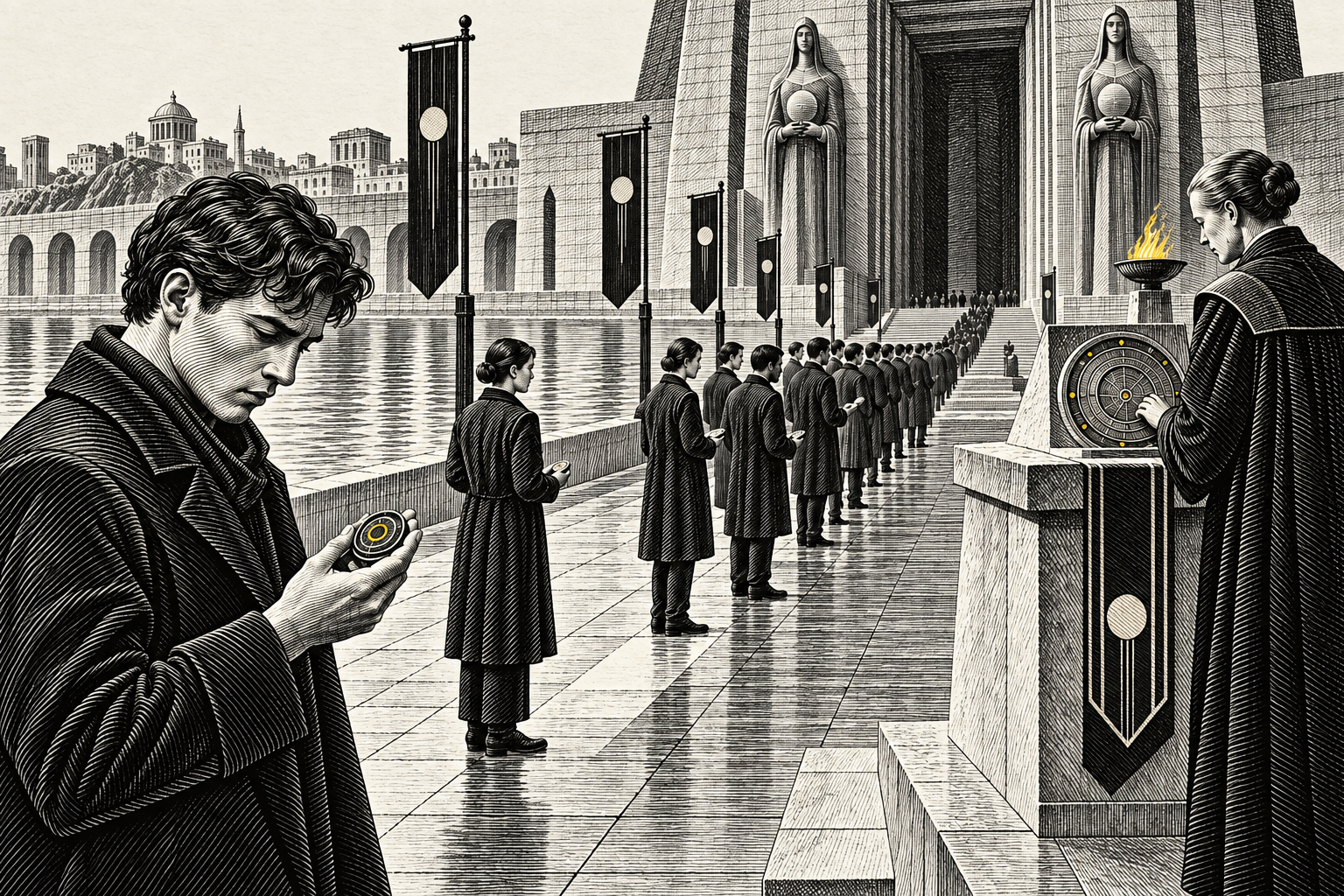
Before the Rite, your sister hands you a small instrument. She keeps its counterpart. These are the paired nodes of Parallax, a system built to read conflicting histories.
As the officiant is about to speak her name, she exploits a vulnerability prepared in his Root Witness. The system cannot find anyone to name. The procession moves on.
In the next second, your family has different memories. Documents, rooms and authorship change. For everyone else, life has always been this way. The ordinary Witness you wear accepts the new history. Parallax preserves the contradiction.
The other node answers. Your sister exists — in a history incompatible with yours.
People adopted Witnesses willingly. They helped recall names, confirm agreements and reconstruct medical histories. Over time, that assistance became infrastructure on which rights, kinship and personal continuity depend.
A civilian AI device. It creates signed records of permitted events and speech.
A network, an archive, law and ritual. It compares records with documents, material traces and recognition by others.
The account of past and present that has acquired public force. In this world, its stability has physical consequences.
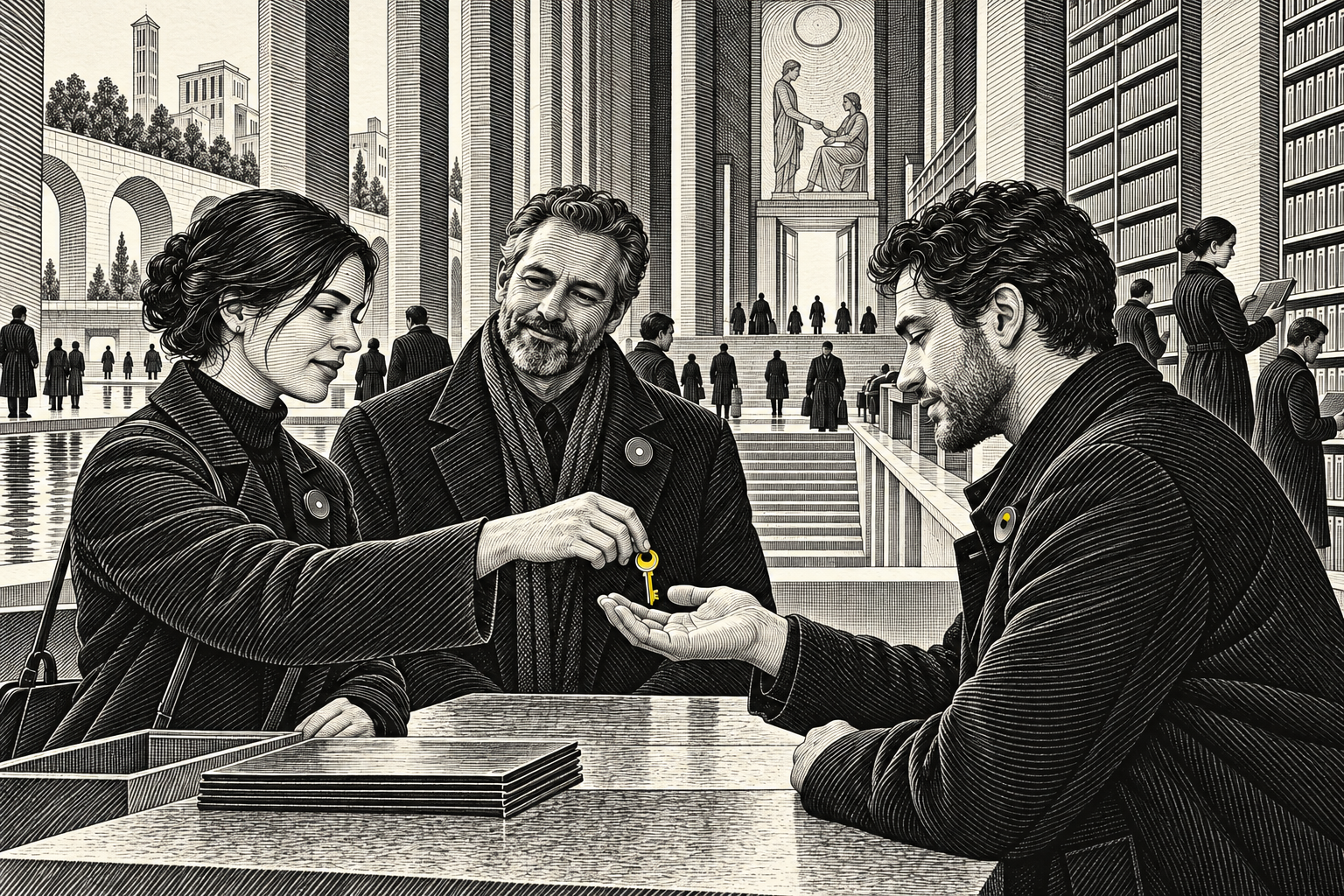
Power lies in interpretation: what a record means, who is trusted and which contradictions society is willing to preserve.
Official Parallax systems help auditors reconcile conflicting testimony into one state. Your sister's modification preserves the conflict. She keeps one node. The other gives you an address in a history the rest of the world no longer recognises.
NODE A / WITH YOUR SISTER
NODE B / WITH YOU
An Index inside Parallax is an address record for a person, object or state. It helps locate a connection, but cannot by itself tell you whether this is the same person.
In one history, the bridge is broken. In the adjacent one, it is intact. Parallax lets you hold both versions of space for a few seconds: step onto another surface, cross the gap and reach somewhere that had no route before.
The illustration depicts the intended Hold mechanic. Mechanics and story follow the project's working canon.
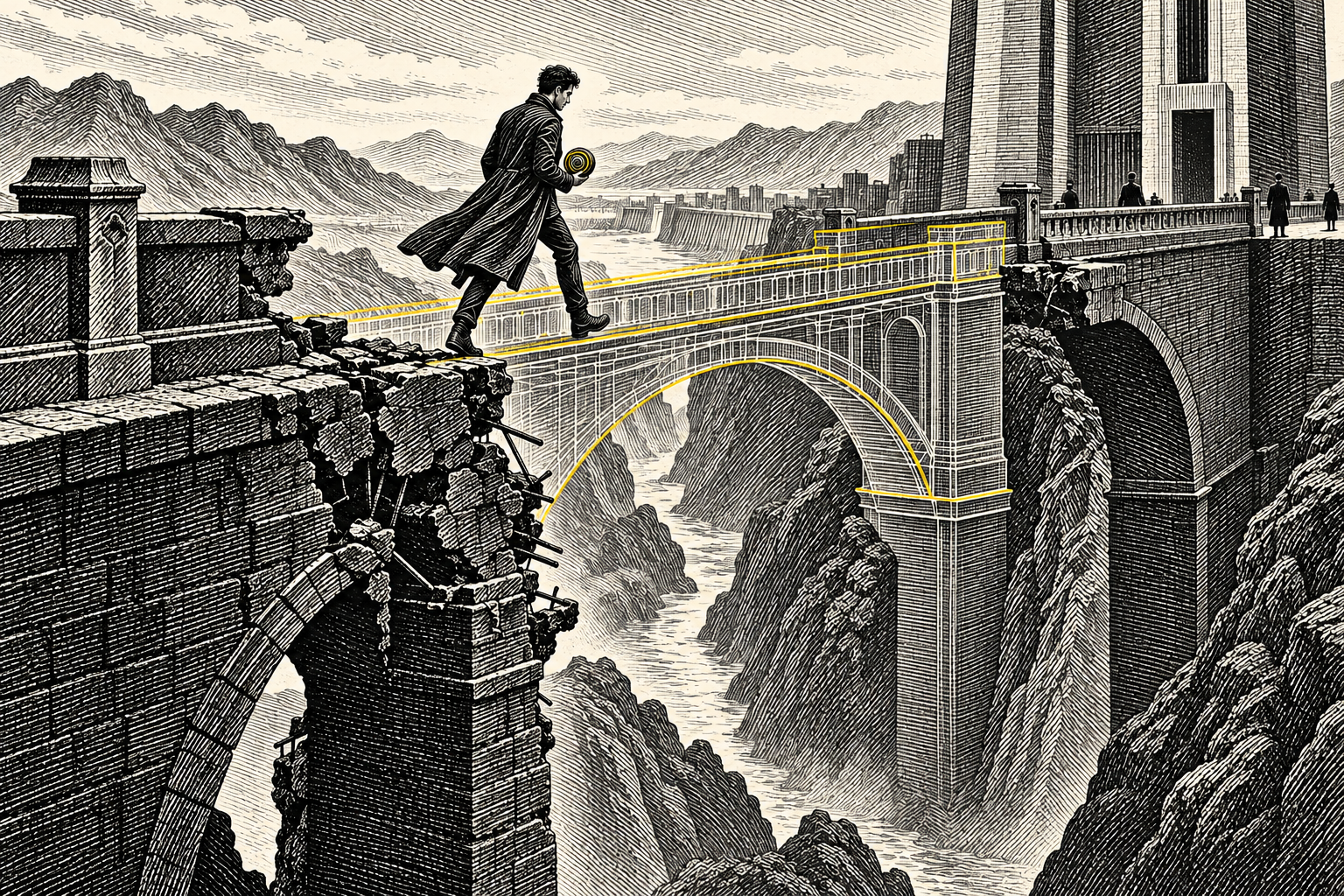
Reveals the adjacent history.
Briefly makes part of it physical.
Establishes another present.
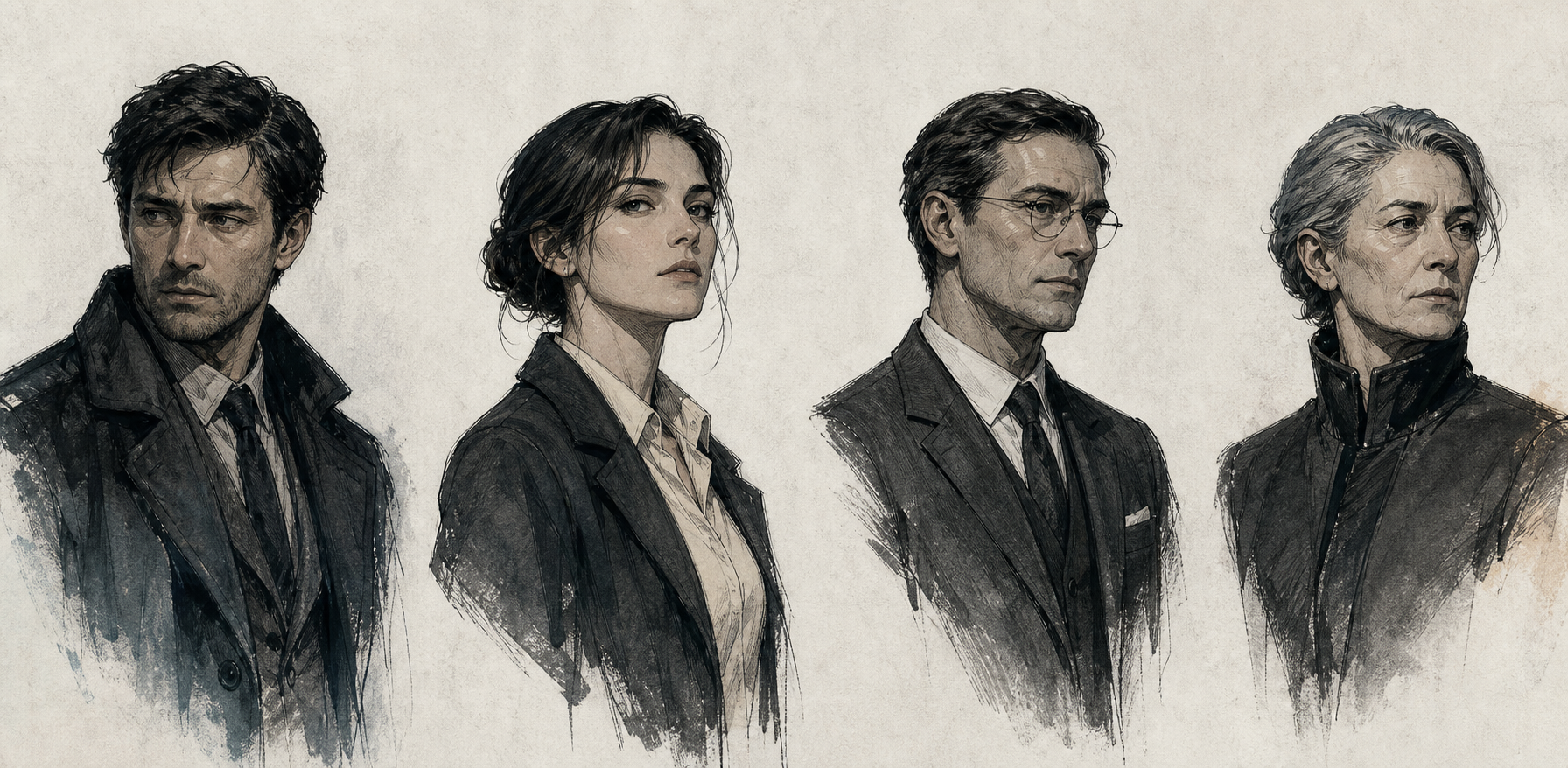
Remembers a bond that no longer has a place in shared history. His search for his sister begins with this single disagreement.
Plans her own disappearance and leaves her brother the second node. She has a purpose of her own that he must come to understand.
Represents a world in which contradictions can be preserved as knowledge. Behind every record is someone's lived life.
Has seen families, agreements and identities torn apart by incompatible histories. He offers stability — at a price everyone will share.
If there are several equally convincing versions of someone you love — whom, exactly, do you love?
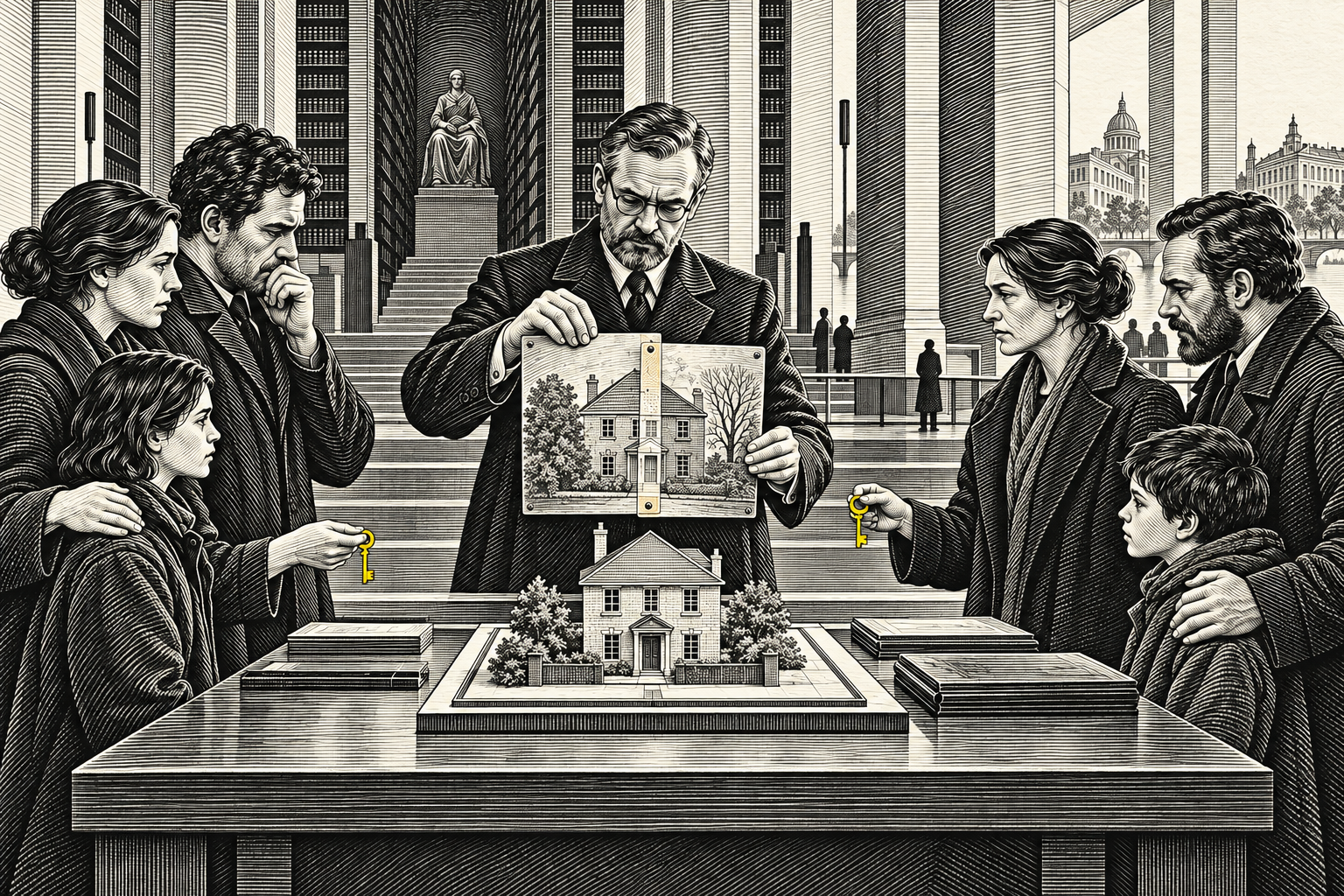
Shared history, law and infrastructure.
Censorship and enforced compatibility.
Freedom from a public name.
Weak long-term memory and fragile obligations.
Knowledge and conflicting testimony.
People risk becoming research material.
Recurring forms of memory and ritual.
Difference can be declared a distortion of a single order.
A capital, archives and monumental squares. Identity exists here through recognition.
Journeys, oral genealogies and moving centres. A name is held by routes and relationships.
Acoustic temples, cold water and vertical thresholds of knowledge. Archaeology becomes an ascent.
Incompatible architectures converge around the mechanism of the Great Canonisation. The promise of stability becomes a final choice.
In the allegory of the cave, a person tries to understand what lies behind an image. In Specus Fiction, that question becomes social: who confirms what was seen, whose memory carries weight and what happens to someone whom shared history can no longer accommodate.
Specus Fiction is a single-player RPG in development. This page introduces its lore and artistic direction; the illustrations are concept art.
Based on the project bible, World and Story, and Art and Space. Working canon dated 23 August 2026. The narrative engraving series was created with OpenAI ImageGen for this page; the earlier portraits come from the project repository.